|
|
REPLACE your End Grain WOOD
BLOCK FACTORY floor with Jura
Block™ Polymer Wood fiber Block
for long-lasting performance.
NEW MODERN JURA BLOCK IS UNAFFECTED
BY WATER, MOISTURE OR HUMIDITY
AND WILL NOT BUCKLE, SWELL OR
FLOAT AWAY AS END GRAIN WOOD
BLOCK DOES WHEN WET.
IN STOCK FOR IMMEDIATE
SHIPMENT
|
| |
JURA BLOCK
Polymer Wood Fiber Block heavy
duty
floors ARE THE
NEW MODERN INDUSTRIAL FLOORING
SYSTEM
|
Now your plant
floor can have the comfort of end
grain wood block flooring combined
with the dimensional stability of
polymer with JURA BLOCK polymer
wood flooring from Jennison &
Wright. Made of select
hardwood fibers encapsulated and
reinforced in a high density
polymer matrix, JURA BLOCK offers
long lasting performance in most
retrofit or creosote treated wood
block replacement applications.
JURA BLOCK construction makes
blocks lightweight, resilient,
abrasion resistant and
environmentally safe. In addition,
the nonporous composition makes
this flooring block highly
resistant to moisture, oil, most
chemicals, solvents and other
corrosive materials. And, unlike
polymer concrete blocks, these
floor blocks will not chip or
crack. Blocks lay up tight against
each other to eliminate voids and
future hammering of an open joint
from rolling traffic. With JURA
BLOCK flooring your plant floor
will be cleaner, quieter, safer
and remain intact longer.
And JURA BLOCK offers an
additional bonus. Because all
blocks are square and
dimensionally stable, with no
specific top or bottom,
installation is easy using your
regular maintenance personnel.
They’ll be able to install JURA
BLOCK without any special
materials, equipment or training
and with virtually no interruption
of your work schedule. Ideal
replacement for creosted end grain
wood block, fibre block, polyblok
or composite block. JURA
BLOCK is the industry leader.
|
JURA BLOCK polymer wood
industrial floors offer these
benefits:
• Highly Resistant to
Moisture -
Dimensionally stable, nonporous
installed blocks won't swell,
shrink, warp or float away, your
floor will stay solidly in place.
• Environmentally
Responsible - Jura
Block Floors contain no
preservatives or hazardous
chemicals and can be recycled.
• Easy, Economical
Installation - A
simple
retrofit
for creosote treated wood block or
polymer concrete block flooring.
Lightweight blocks can
be easily installed by in
house maintenance personnel with
no special equipment or
training.
• Abrasion and Impact
Resistant -
Absorbs impact and provides strong
uniform load and rolling load
performance. Won't chip,
crack, check or warp.
• Chemical Resistant -
Nonporous
composite
block construction is resistant to
most chemicals, solvents, grease,
oil, water and moisture.
• Controls Vibration
and Noise -
Defuses vibration; absorbs more
noise than polymer concrete or
cementitious floors.
• Reduces Maintenance
Costs - Easy
to clean and maintain.
Machined surfaces fit together
tightly with no voids or open
joints, eliminating hammering by
rolling traffic.
• Reduces Worker
Fatigue -
Resiliency and warmth reduce
worker's foot, calf and leg muscle
fatigue and subsequent claims or
lost time. No need for
costly anti-fatigue mats.
|
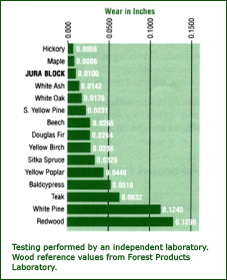
Abrasion Resistance
Abrasion resistance is the
ability of the flooring to
withstand wearing
action. This is
important when considering
its use in heavy traffic
areas.
As shown in the chart,
JURA BLOCK has superior
abrasion resistance
compared with most wood
block flooring. Only
Hickory and Hand Maple
have better wear
resistance. Southern
Yellow Pine shows twice
the amount of wear and
white oak, shows 75% more
wear than JURA BLOCK™. |
Hardness
Hardness defines the
floors resistance to
indentations, wear and
marring. Harder
materials have greater
resistance to penetration,
however the hardness of
material does not
necessarily correlated to
the strength of the
material.
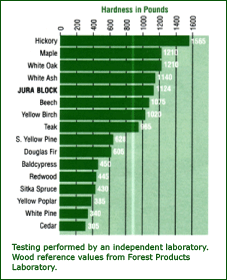
The average hardness of
JURA BLOCK is 1124
pounds. As the chart
shows, JURA BLOCK is
comparable to the hardness
of Oak, Maples and White
Ash (used in baseball
bats). Do not settle
for second best!
|
|
SPECIFICATIONS
Materials
JURA BLOCK Polymer Wood Floor
Blocks shall be manufactured from
select hardwood fibers
encapsulated and reinforced in a
high density polymer matrix.
Blocks shall be top and bottom
machined to the same dimension and
finished solid on all sides, with
no grooves or tapers. Sides
shall be square to the
surface. Installed blocks
shall fit tightly against each
other with no voids or open
joints.
Sizes
Blocks shall be available in a
nominal 4 inches wide by 6 inches
long, in 2, 2-1/2, or 3 inch
depths and finished solid on all
sides.
Packaging
Blocks shall be bundled in
quantities of 14 to 22 blocks
(depending upon size). plastic
banded for ease of handling, and
stacked onto pallets consisting of
60 bundles. The pallet shall
be securely banded with strapping
for forklift handling and
shipping.
|
| Jura Block
Brochure (PDF - 1,881 KB) |
| |
| Back
to top |
|
|